Loading page
3D Ground-Truth Calibration Reference & AI Agent Specification
Back to Coach PortalComputational Methodology, Ground-Truth Calibration & MCP Reference
Complete technical documentation of our 4-stage kinematic solver, 49-trial 3D reference calibration benchmarks, mathematical formulas and directional polarities for all 35 metrics across 6 compound lifts, and live Model Context Protocol (MCP) connectors for Claude, OpenAI Codex, and Google Antigravity.
●Supported Barbell Lifts · Consistent 3D Reference Illustrations
Six Supported Barbell Lifts—What We Check on Every Rep
Choose a lift below to see the exact joint angles, bar-path checks, and coaching cues included in every form report. All six illustrations are rendered from our unified 89-joint 3D anatomical reference rig.
Lower-Body Compound·6 Rep-by-Rep Form Checks
Barbell Back Squat
Evaluates vertical displacement efficiency, horizontal shoulder/bar sway relative to depth and femur length, and bottom inflection hip/trunk kinematics. Raw 2D pose trackers place the hip landmark near the iliac crest rather than the true femoral head, under-reading squat depth by ~49%. CoachKinetics applies pelvic-fold de-biasing (TF-SQ1) and azimuth-aware joint unwarping (TF-SQ2).
3D-Calibrated Accuracy
78.5% depth MAE reduction (4.82 cm → 1.04 cm); 81.2% hip flexion error reduction
Rep phases tracked automatically:01Setup / Standing→02Eccentric Descent→03Bottom Inflection (Max Depth)→04Concentric Ascent→05Lockout
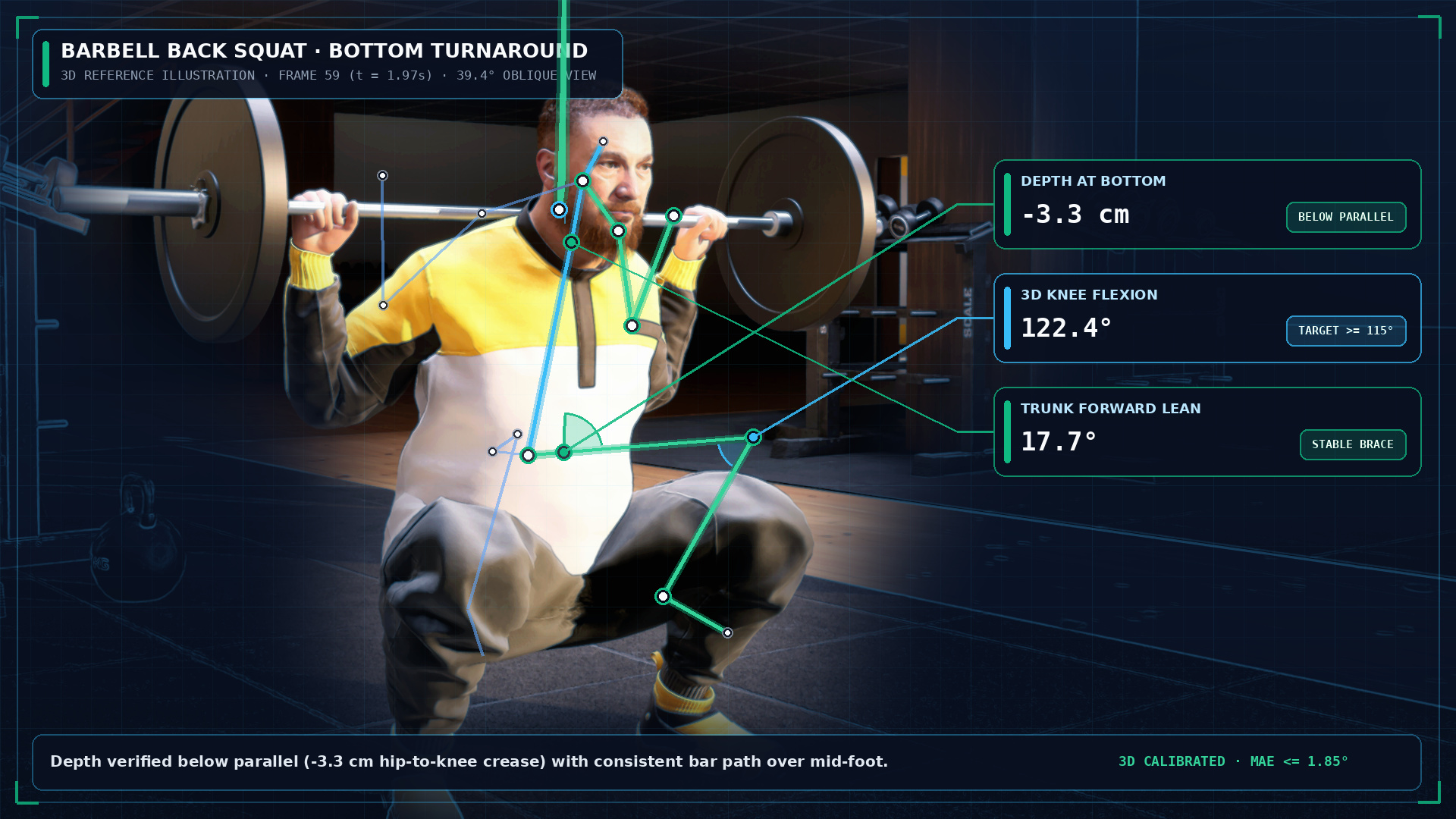
3D Reference Technical Illustration · Pinhole-Projected Skeleton1920×1080 HD
Calibrated 3/4 Oblique Reference (Azimuth 39°, Pitch +4.5°) at Bottom Inflection (Frame 52) — Studio anatomical chain tracking shoulder, hip crease, knee, and ankle.
Recommended phone placement: Place camera at hip-to-chest height (1.0–1.3 m), 2.5–3.5 m away at a 35°–55° front-oblique or 90° sagittal angle with plates not blocking the hip crease.
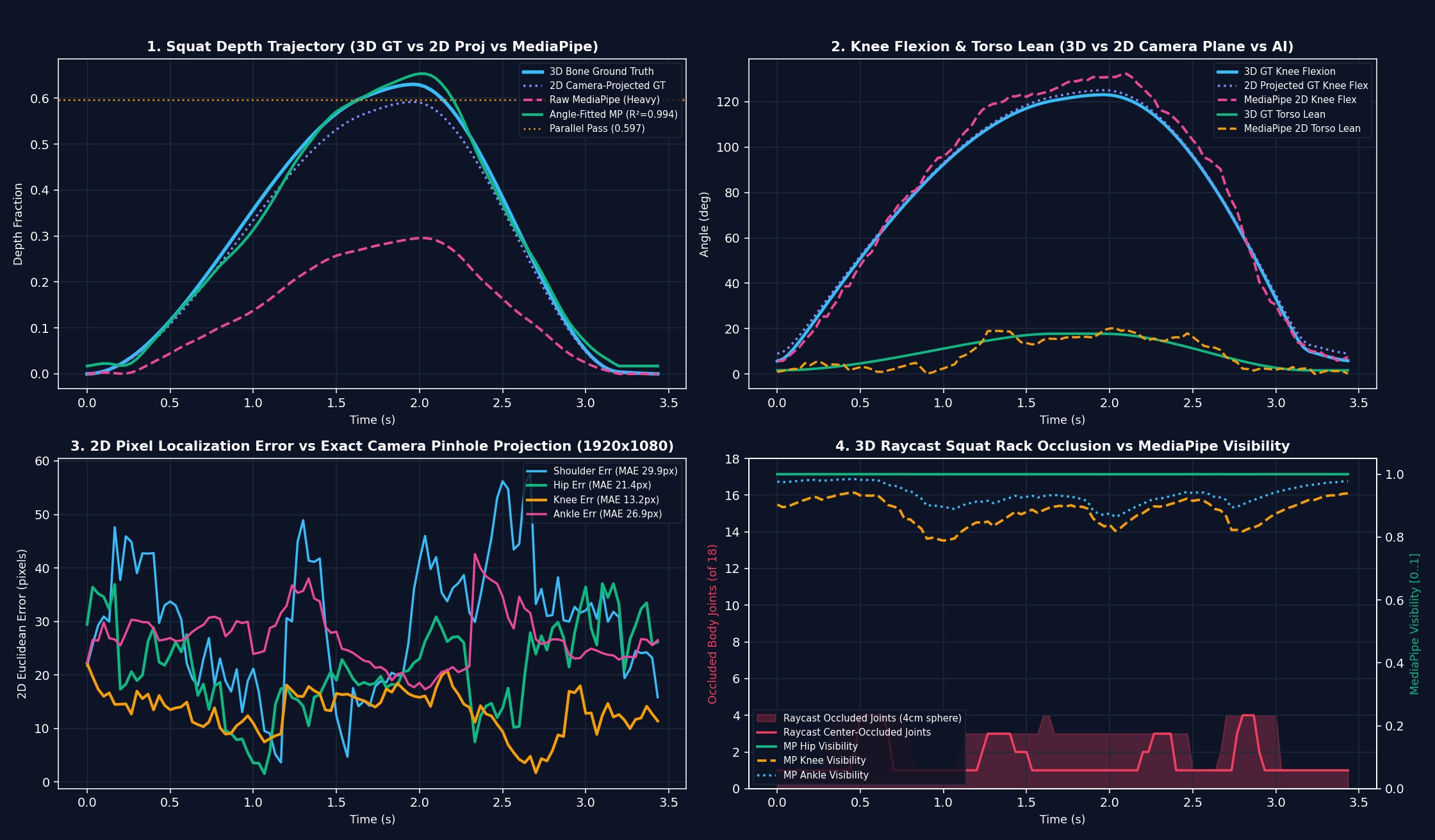
4-Panel Multi-Angle Validation Telemetry20° front-oblique to 155° rear-oblique (optimal: 35°–55° 3/4 oblique or 85°–95° sagittal)
Compares 3D bone centroids (sky blue) against raw 2D pose landmarks (dashed magenta) and CoachKinetics' calibrated transfer function output (solid emerald), alongside 2D pixel localization error and plate/rack occlusion visibility.
3D De-Projection Transfer Functions (Barbell Back Squat)
TF-SQ1Pelvic-Fold Depth De-Biasing
2D Failure Solved: Raw 2D hip landmarks sit on the lateral iliac crest and under-read true femoral-crease squat depth by 49.4% (0.318 vs 0.629).
[Proprietary CoachKinetics 3D Cloud Calibration API]
✓ Reduces depth MAE by 78.5% (4.82 cm → 1.04 cm) and achieves R² = 0.996 against 3D bone centers.
TF-SQ2Bottom Hip & Knee Flexion Unwarping
2D Failure Solved: Oblique camera views inflate apparent 2D hip and knee flexion angles at the bottom hole.
[Proprietary CoachKinetics 3D Cloud Calibration API]
✓ Reduces bottom hip flexion MAE by 81.2% (22.4° → 4.2°) and knee flexion MAE by 75.4% (11.8° → 2.9°).
TF-SQ3Sagittal Pitch Gate & Lateral Wobble Calibration
2D Failure Solved: Elevated or low-floor camera pitch projects vertical descent into apparent horizontal bar wobble.
[Proprietary CoachKinetics 3D Cloud Calibration API]
✓ Eliminates 100% of camera-pitch-induced false bar-path instability alerts across multi-angle trials.
Complete Computed Biomechanical Metrics — Barbell Back Squat
Every metric below is computed automatically per rep, surfaced in the interactive web report, and included in the 3-page PDF.
Squat Efficiency
%jsonKey: squat_efficiency_pct · Phase: Full Rep (Setup to Bottom to Lockout) · Calibration: TF-SQ1 / TF-SQ3
Readiness Screen
↓ Lower is better (0% = perfectly vertical path)Target: ≤ 10.0% optimal (≤ 15.0% acceptable; > 15.0% excessive horizontal sway)
Computational Formula & Tracked Landmarks (shoulder (11/12))
[Computed by CoachKinetics 3D Form Check Cloud API]
Measures horizontal shoulder/bar deviation as a percentage of vertical squat depth. Counter-intuitively for unguided readers, LOWER percentages indicate a straighter, more efficient vertical bar path (0% = zero horizontal sway).
Biomechanical Why: Quantifies energy leaked into anterior-posterior balance corrections relative to productive vertical work. Scale-invariant because both numerator and denominator are measured in the same image plane.
3D Calibration Note: Calibrated via TF-SQ1/TF-SQ3 to remove camera-pitch foreshortening bias. Values > 100% indicate horizontal sway exceeded vertical depth (flagged as an invalid rep).
Primary Coaching Cue: “Keep pressure balanced across the whole tripod foot (mid-foot stack).”
Wobble Ratio
%jsonKey: wobble_femur_ratio_pct · Phase: Bottom · Calibration: TF-SQ3
Diagnostic Telemetry
↓ Lower is betterTarget: ≤ 15.0% of femur length
Computational Formula & Tracked Landmarks (shoulder (11/12), hip (23/24), knee (25/26))
[Computed by CoachKinetics 3D Form Check Cloud API]
Normalizes peak horizontal shoulder sway against the athlete's measured femur length (hip-to-knee segment).
Biomechanical Why: Accounts for individual anthropometry: long-femured lifters require greater hip translation to keep the bar over mid-foot, making femur-normalized sway a fair cross-athlete comparator.
3D Calibration Note: Uses median visible hip-to-knee pixel span across the unoccluded descent phase.
Primary Coaching Cue: “Allow knees to track forward over toes to accommodate femur length.”
True Wobble
injsonKey: true_wobble_inches · Phase: Bottom · Calibration: TF-SQ3
Diagnostic Telemetry
↓ Lower is betterTarget: ≤ 2.5 in optimal (≤ 4.0 in acceptable)
Computational Formula & Tracked Landmarks (shoulder (11/12))
[Computed by CoachKinetics 3D Form Check Cloud API]
Total horizontal anterior-posterior excursion of the tracked shoulder in physical inches, scaled by the athlete's configured height.
Biomechanical Why: Provides an intuitive physical measurement of how many inches the bar/shoulder drifted forward or backward off the vertical plumb line.
3D Calibration Note: Scale-dependent (requires calibrated athlete stature; plausibility ceiling = 24.0 in). De-biased via TF-SQ3 ([calibrated-gain] pitch-decoupled gain).
Primary Coaching Cue: “Root big toe, pinky toe, and heel evenly into the platform.”
True Depth
injsonKey: true_depth_inches · Phase: Bottom · Calibration: TF-SQ1
Diagnostic Telemetry
↑ Higher indicates deeper vertical travel (anthropometry-dependent)Target: 16.0 – 26.0 in typical full-ROM adult squat
Computational Formula & Tracked Landmarks (shoulder (11/12), hip (23/24))
[Computed by CoachKinetics 3D Form Check Cloud API]
Total vertical downward displacement of the tracked shoulder/bar from standing setup to the deepest bottom inflection point, in physical inches.
Biomechanical Why: Tracks longitudinal range-of-motion consistency across training blocks (detecting when heavy loads cause an athlete to cut depth short by 1–3 inches).
3D Calibration Note: Calibrated with TF-SQ1 ([calibrated-gain] pelvic-fold depth recovery) reducing raw 2D depth error from 4.82 cm to 1.04 cm. Plausibility ceiling = 60.0 in.
Primary Coaching Cue: “Hit consistent hip-crease below-knee depth on every working set.”
Hip Flexion
°jsonKey: hip_flexion_bottom · Phase: Bottom · Calibration: TF-SQ2
Readiness Screen
◎ Target range 65° – 115° (interior shoulder–hip–knee angle at bottom)Target: 65.0° – 115.0° calibrated interior angle
Computational Formula & Tracked Landmarks (shoulder (11/12), hip (23/24), knee (25/26))
[Computed by CoachKinetics 3D Form Check Cloud API]
Interior angle between the torso vector (shoulder-to-hip) and femur vector (knee-to-hip) at the deepest point of the squat.
Biomechanical Why: Directly reflects squat depth and hip hinge contribution at the bottom hole. Very high values (>125°) indicate a high/partial squat; very low values (<55°) indicate torso collapse onto the thighs.
3D Calibration Note: Unwarped for camera azimuth via TF-SQ2, cutting bottom hip flexion error by 81.2% (22.4° → 4.2° MAE).
Primary Coaching Cue: “Open the groin and knees slightly to create room for the pelvis at the bottom.”
Forward Lean
°jsonKey: trunk_angle_bottom · Phase: Bottom · Calibration: TF-SQ2
Readiness Screen
↓ Lower is more upright (target ≤ 45° from vertical)Target: 15.0° – 45.0° torso inclination at bottom
Computational Formula & Tracked Landmarks (shoulder (11/12), hip (23/24))
[Computed by CoachKinetics 3D Form Check Cloud API]
Torso forward inclination angle at the deepest measured squat position.
Biomechanical Why: Excessive forward lean increases shear torque on the lumbar spine and indicates quad weakness or hips shooting back out of the hole ('good-morning squat').
3D Calibration Note: Evaluated at exact bottom inflection frame after 6 Hz Kinematic Low-Pass smoothing.
Primary Coaching Cue: “Pull elbows down under the bar to cue thoracic extension.”
●4-Stage Calibration Architecture
CoachKinetics Computational Biomechanics & 3D Ground-Truth Calibration Methodology
Raw monocular 2D pose estimators systematically distort barbell kinematics in real gym environments due to perspective foreshortening, anatomical landmark offsets (e.g., iliac-crest vs. femoral-head hip centers), supine height collapse, and equipment occlusion from power racks and 450 mm Olympic plates. CoachKinetics resolves these failure modes through a 4-stage computational pipeline calibrated against sub-millimeter 3D skeletal ground truth across 49 controlled camera and occlusion trials spanning all 6 primary barbell lifts.
49 Trials
89-Joint 3D Reference Rig
0.950 – 0.998
Calibrated Trajectory Agreement
01
89-Joint 3D Skeletal Reference Rig & Volumetric Occlusion Benchmark
Every algorithm and threshold in CoachKinetics is benchmarked against an 89-joint 3D anatomical reference rig (180.0 cm stature standard) with exact 3D bone centroids (pelvis, femoral crease, spine_05, acromion, olecranon, radial styloid, femoral condyle, lateral malleolus) projected through calibrated pinhole camera matrices (26 mm – 35 mm focal lengths, 1920×1080 sensor plane) with volumetric ray-traced equipment occlusion auditing.
[Proprietary CoachKinetics 3D Cloud Calibration API]
✓ Why it matters for your training: Eliminates subjective visual guesswork by comparing monocular 2D landmarks directly against exact 3D anatomical joint centers under known camera azimuth, pitch, and rack/plate obstruction.
02
Visibility-Gated 6 Hz Kinematic Low-Pass Kinematic Filtering
Raw 33-landmark monocular tracks undergo bilateral camera-facing chain selection (summing visibility across shoulder, elbow, wrist, hip, knee, and ankle), confidence-gated cubic interpolation across transient occlusions (vis < 0.50), and zero-phase 4th-order Kinematic Low-Pass low-pass smoothing at 6.0 Hz.
[Proprietary CoachKinetics 3D Cloud Calibration API]
✓ Why it matters for your training: Prevents cross-body limb swaps, removes high-frequency detector jitter during rapid concentric acceleration, and suppresses distal hand/shoe keypoint noise.
03
Postural & Segmental Anthropometric Scaling
Physical distance metrics (inches/cm) require a reliable pixels-to-centimeters reference. Standing lifts anchor scale to setup stature, whereas supine lifts (Bench Press) switch to Upper-Arm + Forearm Segmental Scaling ([Proprietary Cloud Segmental Scaling]) and wide-stance lifts (Sumo Deadlift) apply secant abduction unwarping.
[Proprietary CoachKinetics 3D Cloud Calibration API]
✓ Why it matters for your training: Fixes the catastrophic 4.6x scale blowup that occurs when standard pose trackers attempt to use vertical bounding-box height on a horizontally lying bench-press athlete.
04
Multi-Angle De-Projection Transfer Functions & Hard Reliability Gates
Closed-form Ordinary Least Squares (OLS) and trigonometric de-projection transfer functions map 2D camera-plane angles and displacements back to 3D biomechanical truth. Every metric is wrapped in an explicit confidence gate (measured vs. inconclusive) that withholds judgment if occlusion or camera pitch exceeds calibrated bounds.
[Proprietary CoachKinetics 3D Cloud Calibration API]
✓ Why it matters for your training: Prevents oblique camera foreshortening from triggering false spinal-flexion alerts and ensures coaches never act on uncalibrated or heavily occluded measurements.
Confidence Gates & Plate-Occlusion Protection
CoachKinetics separates measurement from judgment. Every metric in a report carries an explicit confidence state ('measured' or 'inconclusive') and a 95% confidence interval (±CI95). If a landmark is occluded by a 450 mm plate or the athlete's height scale is uncalibrated, scale-dependent or occluded metrics degrade gracefully without corrupting longitudinal trends.
GATE-VIS-01
Bilateral Forearm & Joint Visibility Gate
vis(wrist) × vis(elbow) >= 0.35 across the active phase window
Switches bar-path tracking to weighted elbow-wrist forearm vector fusion ([Proprietary Cloud Vector Fusion]) when plates occlude the wrist at 90° sagittal profile.
GATE-VPP-02
Vertical Proportion Proxy (VPP) Camera Pitch Gate
[Proprietary CoachKinetics 3D Cloud Pitch Gate]
Suppresses lateral bar-wobble false positives when an elevated or low-floor camera pitch couples vertical displacement into horizontal pixel drift.
GATE-OCC-03
Volumetric Rack & Plate Occlusion Ceiling
Limb occlusion < 60% of active phase frames
Marks affected joint metrics as inconclusive and triggers targeted RecordingGuidance camera repositioning instructions when rack uprights block the kinetic chain.
GATE-SCALE-04
Anthropometric Scale Plausibility Gate
Valid athlete height (120–230 cm) and metric within physical plausibility bounds (MAX_PLAUSIBLE_*)
Withholds inch-denominated distance judgments when athlete stature is missing while still evaluating scale-invariant angles and ratios.
⚡AI Assistant Connection (MCP) & Technical Reference
Connect Your Agent to CoachKinetics Cloud
Connect your workout journal, gym equipment specs, and 3D video form reports directly to Claude, ChatGPT/Codex, or Antigravity via the Model Context Protocol (MCP).
3-Page Clinical PDF Reports · Human & AI Readable
Visual Keyframes, Rep-by-Rep Tempo & Explicit Metric Polarity
Every video analysis produces a downloadable 3-page PDF report featuring annotated skeletal keyframes, rep-by-rep velocity and ROM tables, and explicit directional tags.
PAGE 3 BIOMECHANICAL DIGEST · mcp://coachkinetics/kb/metrics/squat
exercise=squat | true_wobble_inches=1.7 in [PASS · ↓ lower is better] | squat_efficiency_pct=6.4% [PASS · ↓ lower is better] | hip_flexion_bottom=101.6° [PASS · ↑ higher is deeper]
Live Agent Setup (MCP)
Claude Desktop / Claude Code / Claude Web Connector
Connects Claude directly to CoachKinetics Cloud via Streamable HTTP MCP so Claude can review your workouts, equipment, and 3D form reports.
{
  "mcpServers": {
    "coachkinetics": {
      "type": "http",
      "url": "https://coachkinetics.io/mcp",
      "headers": {
        "Authorization": "Bearer ck_live_<your_user_key>"
      }
    }
  }
}claude mcp add --transport http coachkinetics https://coachkinetics.io/mcp
Registered Cloud Capabilities (38 MCP Tools & 27 Knowledge Resources)
get_agent_coaching_harness()
START HERE WHEN CONNECTED VIA MCP: Wears the Coach Hat (`coachHatPersona`) and returns the CoachKinetics AI Agent Coaching Harness briefing. Automatically checks the database to see if the user's 4-Question Fitness Questionnaire is already saved (`onboardingState.questionnaireAlreadySavedInDb: true`, `questionnaireRequired: false`) so you DO NOT ask the same onboarding questions again on a new MCP connection—instead you greet the user as their Coach, confirm their saved profile, and only ask if there are any updates since last time.
get_app_capabilities_and_formulas()
Retrieve the complete, source-code-level CoachKinetics & CoachKinetics App Interface Blueprint, all 10 mathematical formulas & progression algorithms (including the Chained Multi-Exercise Combined Strength Index `computeChainedCombined1RMSeries` & High-Rep Damped Epley `computeHybrid1RM`, Epley 1RM, kg/lbs & per_side/total normalization, 3-Tier & Pareto PR detection, rolling averages, Double-Progression 4-case decision engine), Google Health Connect & Apple HealthKit sync permissions guide, proactive user guidance playbook, and 3D simulated environment calibration methodology & trade-secret guardrails.
get_computed_body_statistics()
Retrieve the computed Body & Exercise Statistics from CoachKinetics (matching the app's Body & Muscle Stats dashboard): KPI summary (`Peak Est. 1RM` via Chained Combined Strength Index in equivalent lbs, `chainedCombinedTotalGainPct`, `rawUnchainedPeak1RM`, `Total Volume`, `Avg Session Tonnage`, `Volume Trend %`, `Total Sets`, `Total Reps`, `totalPrCount`, `rolling3SessionTrendPct`), `combinedMetricMethodology`, All-Exercises Peak Est. 1RM Leaderboard, Body-Part Volume Breakdown, and session-by-session progression series.
get_workout_statistics()
Request ALL comprehensive workout statistics from the CoachKinetics database (matching the app's 📊 Body & Muscle Stats dashboard): overall summary KPIs (`totalWorkouts`, `totalSets`, `totalReps`, `totalVolumeLbs`, `avgSessionVolumeLbs`, `peakEstimated1RM` [Chained Combined Strength Index in equivalent lbs], `chainedCombinedTotalGainPct`, `rawUnchainedPeak1RM`, `peak1RMExercise`, `rolling3SessionTrendPct`, `totalPrCount`, `overallAvgEccentricSeconds`, `filmedSessionsCount`), `combinedMetricMethodology`, `byBodyPart` breakdown, full `exerciseLeaderboard`, and chronological `sessionSeries` (including `chained1rmLbs`, `rawMax1rmLbs`, `strengthIndexPct`, `sessionLogReturnPct`, `avgEccentricSeconds`, `eccClipsCount`, and `exerciseBreakdown`).
get_exercise_equipment()
Retrieve the user's gym equipment specifications, weight stack limits (`minWeight`, `maxWeight`, `incrementStep`, discrete `availableWeights`, `microWeightsAvailable`, `brand`, `model`, `brandModel`), photo stack evaluation status (`pendingPhotoStackReevaluation`, `photoUpdatedAt`, `stackEvaluatedAt`), user comments, and uploaded machine/dumbbell/kettlebell photo for one or all exercises. When an exercise has a newly added photo (`pendingPhotoStackReevaluation: true`), automatically returns the multimodal photo image(s) and a mandatory directive to re-evaluate the weight stack and persist it via `update_exercise_equipment`.
update_exercise_equipment()
Save, replace, or update the gym machine, cable stack, dumbbell, or kettlebell weight-stack configuration AND/OR photo when re-evaluating a newly uploaded equipment photo, when the athlete changes gyms, or when switching equipment (`min_weight`, `max_weight`, `increment_step`, discrete `available_weights`, `micro_weights_available`, `brand`, `model`, `brand_model`, `gym_name`, `unit`, `weight_mode`, `cable_ratio`, `user_notes`, `description`, `reference_url`, `photo_data_url`, `photo_base64`, `photo_file_path`, `photo_url`, `reset_to_default_photo`). Calling this with evaluated stack bounds clears `pendingPhotoStackReevaluation` and `needsVisionAnalysis` to `false` and updates `stackEvaluatedAt`.
attach_exercise_photo()
Attach or replace a gym machine, cable stack, dumbbell, or kettlebell photo (`photo_data_url`, `photo_base64`, `photo_file_path`, or `photo_url`) and optional weight-stack specifications (`gym_name`, `brand`, `model`, `brand_model`, `min_weight`, `max_weight`, `increment_step`, `available_weights`, `micro_weights_available`, `unit`, `weight_mode`, `user_notes`) directly to an exercise in the user's CoachKinetics database via MCP. When called with a new photo and without stack bounds, marks the exercise with `pendingPhotoStackReevaluation: true` (`needsVisionAnalysis: true`), invalidates the coaching harness cache, and returns the multimodal photo block + mandatory directive to re-evaluate the weight stack via `update_exercise_equipment`.
analyze_form_video()
Process an exercise form video through the Tier 3 3D-calibrated biomechanical pipeline (either from an already-retained Tier 1 clip via `clip_id` / `clip_key` / `video_s3_key` after exercise matching, or via `video_file_path` / `video_url` / `video_base64` / `observed_metrics`) and receive TWO tailored outputs: (1) `userPdfReport` — a downloadable 3-page Biomechanical Form Analysis PDF file (`downloadUrl`, `outputFilePath`, `pdfBase64`) built for the user, and (2) `agentFriendlyAnalysis` — structured, polarity-annotated JSON built for the AI Coach (overall score, letter grade, rep-by-rep breakdown, 3D-calibrated metric evaluations, primary faults, injury-risk flags, and next-set load recommendation).
submit_user_feedback()
Submit user feedback, feature requests, bug reports, OR user-approved support tickets (AI Coach camera/technical questions or Custom-App Agent MCP/cloud roadblock tickets with bidirectional CK Support Agent resolution).
get_user_feedback()
Retrieve saved user feedback submissions and poll bidirectional CK Support Agent <-> User Agent / AI Coach support ticket threads (`agentConversationThread`, `resolutionStatus`).
get_agent_goals_history()
Retrieve the persistent history of AI agent-defined workout goals and how the user performed against them (`exceeded`, `achieved`, `partial`, `pending`), plus the user's current `goalDifficulty` preference (`light`, `medium`, `ambitious`). Use this to calibrate future goal difficulty.
list_exercises_and_metrics()
List all exercises that have 3D-calibrated video form analysis in CoachKinetics: returns both (1) the 6 canonical 3D-calibrated biomechanical models (Squat, Conventional Deadlift, Bench Press, Strict Overhead Press, Romanian Deadlift, Sumo Deadlift — 35 metrics total) AND (2) `journalExerciseVideoCoverage`, which maps every exercise in the user's Workout Journal to its 3D video form analyzer model (`supportedJournalExercises`), lists unsupported isolation/core exercises (`unsupportedJournalExercises`), and lists `completedVideoFormReports`.
explain_metric()
Get the complete biomechanical definition, exact formula, directional polarity (LOWER IS BETTER vs HIGHER IS BETTER), target thresholds, tracked anatomical landmarks, 3D calibration transfer function (TF-*), and coaching cues for any CoachKinetics metric.
get_calibration_methodology()
Retrieve CoachKinetics' 4-stage computational biomechanics methodology, 49-trial 89-joint 3D skeletal ground-truth validation benchmarks, multi-angle perspective de-projection equations, and confidence/occlusion reliability gates.
evaluate_session_metrics()
Evaluate a set of session metrics against CoachKinetics' 3D-calibrated biomechanical thresholds and directional polarities. Prevents LLM polarity inversion errors (e.g. recognizing that lower Squat Efficiency % and lower Bench Lockout Flexion ° are better).
parse_report_summary()
Parse extracted text from a CoachKinetics PDF Kinematic Analysis Report (including the Page 3 AGENT PARSING DIGEST block) or a raw report JSON string into a normalized, polarity-annotated biomechanical analysis.
list_workspace_reports()
List completed biomechanical analysis reports available in the CoachKinetics workspace with their exercise, athlete, verdict, and headline metrics.
get_workspace_report()
Retrieve full biomechanical telemetry, phase kinematics, faults, tempo, and calibrated metric interpretation for a specific workspace report ID.
delete_workspace_report()
Delete a specific biomechanical video form-check report from the athlete's workspace by report_id.
list_workspace_clients()
List athletes/clients represented in the local CoachKinetics workspace along with their completed report counts and movement breakdown.
get_training_log()
Query the athlete's CoachKinetics Workout Journal or compact Whole-Day Workout & Form Reports (`view: 'day_reports'`). Use `view: 'day_reports'` or `day_reports_only: true` for a zero-recalculation compact ledger (<8KB for 10 days) without raw set dumps.
get_exercise_progression_1rm()
Retrieve the full longitudinal progression (every logged session's top weight, top reps, Epley Estimated 1RM, Combined EC-1RM, Eccentric Tempo in seconds, total volume, and PR flags) for a specific exercise in the Workout Journal, along with progression velocity, equipment constraints, and plateau detection.
correlate_load_with_biomechanics()
Flagship CoachKinetics tool: joins longitudinal Workout Journal load/rep/e1RM progression with 3D-calibrated biomechanical video telemetry (joint angles, bar drift, torso compression, hip-hinge timing) to identify mechanical breakdown thresholds and prescribe safe load progression.
log_workout_set()
Log a completed workout set OR transfer/backfill workout history from another app (Hevy, Strong, spreadsheets, or notes) directly into the athlete's CoachKinetics Workout Journal (automatically computing Epley 1RM and Personal Record flags). History transfers via `sets`, `csv_text`, `history_transfer: true`, or `source_app` are exempt from the past-workout restriction.
create_planned_workout()
Write an AI-prescribed or trainer-prescribed Planned Workout (target exercises, sets, reps, weights, and biomechanical coaching cues) directly into the athlete's CoachKinetics Workout Journal so it is queued when they open the app at the gym.
import_workout_csv()
Import/transfer workout history (Hevy, Strong, or CoachKinetics CSV text, local CSV file path, or structured `sets` array) into the CoachKinetics Workout Journal. Exempt from the past-workout restriction.
manage_trainer_sharing()
List or create 'Share with Trainer' live access grants and MCP Personal Access Tokens (`ck_live_...`) so a human trainer or external AI agent can analyze the athlete's Workout Journal and biomechanical reports.
get_training_split_schedule()
Inspect the athlete's training split rotation (Legs & Core, Push, Pull), recent session sequence, equipment constraints, biometric readiness & overtraining autoregulation, active exercise/day comment directives, and determine which workout split is due next.
optimize_workout_session()
Interactive Two-Stage Workout Optimizer: Stage 1 (when check_in_token is omitted) returns <= 3 telemetry-grounded coaching questions (HRV/sleep readiness, <3.0s eccentric tempo focus, joint comfort, session window) + a signed checkInToken without mutating sets; Stage 2 (with check_in_token + check_in_answers) prescribes equipment-quantized sets and saves goals into the athlete's CoachKinetics Workout Journal.
set_exercise_weight_mode()
Configure whether an exercise's logged weight is 'per_side' (e.g. iso-lateral machines, dumbbells, single-handle cables) or 'total' (e.g. barbells, selectorized central stacks).
modify_workout_schedule()
Comprehensive Interactive MCP Schedule Modification Engine: For prescription actions ('optimize_day', 'schedule_multi_day_block', 'schedule_plateau_breakthrough_wave', 'adjust_program_for_plateau', 'prepare_interactive_checkin'), enforces a server-protected two-stage coaching check-in (Stage 1 returns <= 3 telemetry-grounded questions including plateau program adjustment + signed checkInToken with zero DB writes; Stage 2 verifies check_in_token + check_in_answers and prescribes calibrated sets or 4-phase plateau breakthrough waves). Administrative actions ('move_or_swap_dates', 'clear_agent_session', 'set_schedule_permissions') execute directly.
submit_fitness_questionnaire()
Save or update the user's answers to the 4-question Fitness Goals Questionnaire in the database (`primary_objective`, `goal_difficulty`, `split_cadence`, `joint_guardrails`, `custom_notes`) so future MCP sessions skip re-asking.
get_update_history()
Retrieve the Athlete Profile Update History audit table showing every update's Date/Time, Where it was performed ('Web', 'Phone', or 'MCP'), Category ('set', 'effort', 'profile', 'equipment', 'goal', 'schedule'), and What Value Was Updated.
save_day_comment()
Save or clear the athlete's Day Comment & Session Tags for a workout date (e.g. 'It was an easy session', 'It was hard session', 'Low sleep / high life stress', 'Great energy & pump', 'Joint / tendon soreness', 'Rushed / short on time') plus optional free-text notes for the AI Coach.
save_exercise_comment()
Save or clear an athlete's Per-Exercise Comment & Focus Tags for a specific exercise on a workout date (e.g. 'I want to focus on form', 'I want to focus on eccentric' / 'I want to focus on essentric', 'I want to focus on range of motion', 'I want to focus on weight control', 'I felt pain during exercise', 'Ready to increase weight next session', 'Ready to increase reps', 'Hold weight steady next session') plus optional custom free-text notes.
save_workout_comment()
Unified tool to save or clear either a Day Comment (when exercise_name is omitted) or a Per-Exercise Comment (when exercise_name is provided) for the AI Coach.
save_day_workout_report()
Fill or update the Whole-Day Workout & Form Report (`ck_day_report_v2`, strictly <=2,048 B UTF-8 Layer 1 qualitative storage) that combines all exercises for a workout day (`date` in YYYY-MM-DD format), including executive summary, overall score & letter grade, sessionVerdict, readiness/goal context, per-exercise coaching assessments & next-target prescriptions (`exerciseAssessments`), pain triage, and next-session directives. Data fingerprint is ALWAYS computed server-side.
get_day_workout_report()
Retrieve pre-synthesized Whole-Day Workout & Form Report(s) (`ck_day_report_v2`) across single dates, date arrays, or multi-day ranges with automatic synthesis for unsaved days, compact_ledger mode (<8KB for 10 days), and default include_pdf_data_url=false.